Ok, I’ve been reading half of it now and can contribute with some.
Background: the beginning is kind of an explanation concerning why these two artists where her choice, with focus on gender-, ethnical-, and cultural aspects.
Apparently the author (herself a singer) was fascinated by Stinas "little and fragile" voice with all its unique expressions (which isn't strange at all), which reminded her of Björk, but still in a whole new aesthetic way.
The thesis theme is about whether its possible to find traces of musical culture and tradition in the two artists voices, how this have developed or changed their style and if it can be seen as innovative.
Then there is a lot of theory and method (some Barthes, Mukarovsky and Kristeva etc.), which is interesting, but probably not relevant for this forum.
First chapter after introduction, a bit down (page19): Stinas own thoughts and visions about her music, which is (as we know) all written and performed by the artist alone. "Crime" is the only song that is given an complete analysis later on, with which the author tries to question whether or not we can take Stinas own claims seriously, interpret if it is "authentic".
About the lyrics in general: "The question will therefor not only concern what is said - the words content, but also how it is said - what kind of language one uses, and in which tone it is said." (p. 22)
Then, about cultural context, that is the swedish music scene ”if it is national or international”, adding the ”problems” which can occur when using english instead of the native language (that is, the artists identity, and the author has an interesting aspect that since sweden havn’t been in war for 200 years, we don’t tend to focus on the national aspects of the artist)
Chapter 2. Biographical stories about her music.
About 1994, second album, stop giving concerts, don’t want to be a public person, being sceptical against the musicvideoconcept, the artexhibitions of 2005.
Then an analysis of the ”And she closed her eyes”-cover (I don't know why):
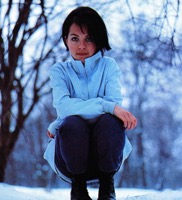
”The picture of SNs cover is in different grey tones with small parts of blue. The background is a bit ’industrial’, with gravel, stones, asphalt and iron as central elements. SN is also placed outside, but in a much ’colder’ and more urban environment. Many of the pictures is unclear, taken in backlight or from a distance, something that gave a lot of them a dreamlike characteristic. SN drop down her gaze, or have the black hair hanging over her face.”(p.46)
She looks “vulnerable”. Maybe because her bad upbringing, the author says, but also this could be and artistic construction, to represent herself in a specific way, that Nordenstam is rather playing with peoples impression of the artistic-role.
”SN doesn’t understand the common interpretation of her as fragile and melancholic. Her intention is to create intimacy and closeness.” (p.47)
A small bonus: “Even though she (Stina) has avoided the most of promoting, she has still gained a devoted fanbase” (p.42)

[There are some biographical remarks on Stinas teendepressions, familyissues etc. which I will not translate since you seem to have that specific respect at this forum.]
I’ll continue to read the end soon.