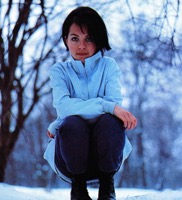
with rare photos, including one of Stina with The Flippermen (the only one I've ever seen)!
What's more STRMBRG has translated the whole article into English, so we owe him a huge debt of thanks.
The reason I'm uploading it is because STRMBRG wanted to upload the article as a pdf, but that isn't possible here, so he sent it to me and I've converted it to jpgs. I've been hunting for this article ever since I discovered its existence within the Swedish Library. So without further ado:-


And here is STRMBRG's translation. Fantastic stuff!!
" Stina on her own feet!
Stina Nordenstam is a singer who maintains her own expression. Walking someone else's path is not her tune. Therefore, she makes her own lyrics, original songs and arrangements. "I do not have time to become good,"she explains." What I want to give my audience does not require any great technical skill."
EVA Myrenberg RAYMOND interviewed , CHRISTER LANDER BRANCH photographed.
She is remarkably small and neat in appearance, but by no means difficult to distinguish, neither among the musicians on the stage or in the amount of what is called jazz singers.
On stage Stina Nordenstam is obviously in the center with her singular bright voice, her own way of singing and a repertoire that she has created herself, and based on her own experiences - not borrowed from American nightclub environment.
Her expression testifies strong will and great privacy. She sounds like no one else, and she does it with an uncanny authority.
Last year she was awarded the association Fasching’s Friends scholarship for young musicians, this summer, she made an acclaimed appearance at the Skeppsholmen Festival. Now she can be heard here and there in the country: the attention has made her in demand, her artistic individuality interests and fascinates.
21 years old, she grew up in Nacka and the music was a natural language since childhood. Dad played swing piano at home and played music together with Stina and her little sister when they were little.
Then she ended up in the local music school, learned to play the violin and read music, played string quartet and sang in several choirs.
Jazz was "in"
At twelve years of age came Stina to Adolf Fredrik Music School in Stockholm. There, she dropped paradoxically all interest in music.
- I thought I sang bad, I did not like it. I was more interested in the Swedish language, thinking of becoming a journalist.
But it was music anyway: the music program at Södra Latin made singing pleasurable again.
- There I became friends with a couple of guys who were fanatically interested in jazz and playing the saxophone. We listened intensively to CDs and played music together. Jazz was the big fashion thing for me .
After singing at morning assembly Stina got a cassette from a friend who had been there and listened . On it was music with the singer Rickie Lee Jones. Stina could identify with what she heard and started to become more aware of their own voice .
Many of the great American singers were more difficult to identify with for Stina's part, though, during her "jazz digging" period she was heavily influenced by these and she even, as she mentions, got a darker voice. Stina's voice is by nature anything but dark.
No good student
Now, Stina Nordenstam is at the Academy of Music - with mixed feelings.
- I'm not a particularly good student , I am different . Most people work and work to become skilled instrumentalists . This I do not think that I have time for. I want to do what I can with my voice, that's what I have, actually , and I have a lot of ideas about how it should be framed.
For this, she has a solid musical grounding. Taking singing lessons, she is not particularly keen on : great technical skill is not necessary for achieving the strong effect she seeks.
- I do not like practicing scales, it makes me feel so bad . Listening to music I do, of course , and pay attention, but I do not think there's any interesting musician or singer who can give me something through direct teaching right now. Most of it comes when I'm sitting by myself.
To seek her own expression is central for Stina Nordenstam, to walk someone else’s way is unthinkable. She speaks with slight consternation about how people can go for years in school only for merit’s sake, and the rigorous career conditions for classical musicians with a lot of "musts". When it comes to jazz, the room for maneuvers is bigger, she says.
- But even here there are a lot of requirements and conditions. At Fasching, for example, there are a lot of unspoken rules, how to go to the jazz tradition can also be heavy. And, sure, I know the way that it should be, but singing jazz-wise is not obviously what gets me. I do not want to back out of the jazz context, but do not want to be fenced in by it. I can not belong to any group.
Not in Swedish
Instead, she wants to carve out her own space, her own shape. In "Stina & The Flippermen" she arranges her musical material - that which she herself has composed and set text to. This band has emerged gradually from a collaboration between herself and pianist Anders Persson, who she met at a jazz course in Umeå several years ago.
- It's a fun band to work with, the musicians have respect and esteem for the compositions and arrangements. But they also know how to color the music with their personalities and experiences. Sometimes I think I’m better at getting through with the intent of the songs when I work alone with my recorder tape recorder. Maybe I would most like to play all the instruments myself...
It is alone with a tape recorder, guitar and piano, she is working out her repertoire. The songs she creates are based on real experiences, developed and interwoven with imagination.
She looks for the music inside her. That's where she finds what she wants to express. She writes lyrics in English. Swedish she knows too well, the wealth of shades make it too complicated. And she doesn’t feel that she carries any Swedish song tradition – she has always practiced writing English lyrics.
- There's really not that many ways to do it, she says. There is only now.
Form and rhythm
And she shows a text that just came directly and remained so. Ideas and whims she collects in notebooks. In some places, the texts are equipped with rhythmic notation so that she will remember how she put the emphasis from the beginning.
When I look in one of her books, I see a strange word in the text - and she explains that "the word is not done yet ." The order of forms and rhythms seem to be as important may Stina as their meanings.
Well, her career then - would she like to live like this, writing music and singing?
- Yes , but I will never adapt my music for the sake of it , that I just can not do. I feel that I must do what I do. If I were to lose my voice, I would still continue in some way.
She wants to have control over her artistry. To get into situations where she can not decide tempo and mood she finds awkward. Such as when she starred in a TV program with Berndt Egerbladh - and through this also had the opportunity to sing at Mosebacke.
Not being able to participate in someone else's auspices she sees as a limitation. More recently, she has turned down several offers just get that she felt that "it's not me." But it's important to her that she does feel genuine hundred percent, she'd rather not deliver something that she does not fully stand for.
Very alone
On Mosebacke Bosse Stenhammar heard her in front of a completely silent audience. That's how she got the job at Skeppsholmen in summer.
- On Skeppsholmen I felt I beamed. I enjoyed it! It was a big step, nothing will seem bigger. Now she hopes to perform at more festivals, preferably abroad. And in the studio she works willingly.
- It would be fun to do a few records in my life. Actually, maybe I'm more a producer than a singer - I want to create a whole that should be able to give a strong impression to the listener.
The great attention surrounding her person lately she regards as the fruit of favorable interacting factors .
- Much has just worked out. Though concerning the media they expect so little - they already have their minds made up . It's nice when people are interested in what you do, especially as I think the music is worth it . But you soon discover that music is not the most important thing for everyone - some media people use you for their own interests.
Competition in Sweden is not exactly overwhelming either, thinks Stina.
- Many sing, but nothing more. I have not stuck to singing jazz standards, to my own satisfaction. But I have been very lonely.
Stina Nordenstam’s singing is something intimate, naked and direct. Does she think that the audience perceives the music as she wants?
- I think so, although they may not know about it themselves. "Delicate" said one after the concert on Skeppsholmen, but I think this is not the right word. I myself think that there is more outreach than that. I take what I do seriously, though even so, I won’t die if not everyone accepts it.
Caption
Stina and her Flippermen , top from left, Christian Spering bass and David Wilczewski saxophone , below from left, Max Schulz, guitar, Stina herself and Anders Persson piano. Not pictured Malando Gassama percussion. "

