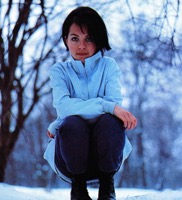
It was a radio drama-documentary about some of the early Arctic pioneers,based on diaries of an Austrian expedition.Very tragic and moving actually.I have an English translation somewhere.Stina reads and provides some of the music-obviously not The Blue Danube (they're Austrian,geddit).
'Isens fasor'='Horrors of the ice'
Here's the translation:- Someone at CQD did it,I forget who! Sorry whoever you are....
Posted - 04 May 2004 : 15:04:09
------------------------------------------------------------------------
Here is the translation I did of the audiopiece "Isens fasor" (The Horrors of
the Ice). I hope you all now fully can enjoy this including Stina's music and
voice, as much as I did.
------------------------------------------------------------------------
At the time when there still were white spots on the map, an ill-equipped expedition of Austrian militars and Italian seamen set out to sea in the search for the Northeast Passage. After only a few weeks they got stuck in the ice and were ice-bounded there for two years.
The Radio Theatre presents; The Horrors of the Ice.
Diary fragments from the Austro-Hungarian North Pole Expedition of 1872.
Narrated by Stina Nordenstam, in a freely fabled version by Peder Bjurman.
Id?a and direction Bogdan Szyber and Carina Reich.
If a human steps out naked on the ice, the Arctic cold would create a cloud of fog around that person. And if the light comes from the right angle, the borders of this cloud would shine in all the colours of the rainbow; blue- violet, blue, yellow, orange, red-yellow.
The extinction of these colours would represent the stages when you are freezing to death; a death visible into the very last, when the red-yellow bow fades away. That is the dying at the North Pole, alone and extinction like a will-o'-the-wisp.
A few sea-gulls can still be seen sailing around. They visit the spots of open water around us. With short wing strokes they are hovering above the top of the mast, staring down at us and with hoarse screams they pass fast as an arrow to
the south. Away from this shadowland that is awaiting us. We are stuck. It's as simple as that. Nothing can move us. Ice-bounded here all winter or the night.
The ship is now our only protection against the cold. It has only been a short dream, the purpose of our journey. With sorrow we watch our slowely failure. With lack of willpower and for an indefinite time we are being brought into the darkness.
It is summer, the second and it's thawing in the days. From the lookout open water is sighted far away. The summer's break-up of the ice doesn't reach us.
Yet another winter is waiting for us.
The dogs are wild and Gillis, the big Newfoundland dog, tears apart the last cat from Tromso, that has survived until now. The only creature we could feel some kind of affection for. The death of the cat is causing the men deep sorrow. Everyone was very fond of the animal, especially the Tyrolese Klotz,
who almost got tears in his eyes. Most of us are loosing teeth, the gums swell up and suppurate. The scurvy abscesses have to be cut off with sissors and the wounds burned with acid.
The face is deformed by chilblains, the hands are covered with wounds. The frost deposit along the planking inside the ship is as thick as one's arm, the blankets are frostbound and there is a smell of smoke from the stoves. Several of the crew have a racking cough, the engineer is confined to bed, back
a month. The ship's doctor does his best to encurage him that he soon will be well again, despite all hope seems to be gone.
When hunter Klotz returns to the ship from the bear hunt out on the ice, he pulls off his frozen fur, mittens and the face protection of leather, and suddenly he gets on his summer suit. He goes up on deck with his rifle on his shoulder, standing there for a long time with his eyes in the remote distance. He is only staring out over the ice, doesn't answer when spoken to. Later when
we look for him up on deck, he has disappeared without a trace. The search teams are sent out in all four cardinal directions. After five horror-filled hours he is finally found, bare headed and with his face covered with ice he is passing slowely with dignity towards the south, home to Tyrol, home to his valley. Without a word he lets himself be brought back to the ship. The
clothes breaks off his body, he defrosts with warm water, rubs warm and is put in his berth, reserved and without a word. He stays there for the nearest future, almost a month quiet in his bed, away from the world, away from everything. But one day he suddenly rises, gets dressed, grabs his rifle and reports for duty to the deck watchman. We drift with the ice far more north, latitude by latitude at a snail's silence pace of the drift ice.
And then we spot something, suddenly from nowhere it emerges far, far away, a ship or an optical illusion, a new continent. First just a small spot, then larger, until mountains appears, black to all the white around. The closer we drift the higher rises the land, higher and higher out of the sea.
-We herby name you after the emperor of Austria; Franz Josef Land. The expedition has by mere chance or with the help of God, to where the ice drifted us, been taken to a new unknown land, never before seen by man. No one has ever before walked its ground or climbed its mountains. An ice kingdom of
virgin land and barren as a sterile stoney desert with its thin crust of ice that covers all.
Payer is training for the exploration and the upcoming triumph. The dog sled is prepared. Under Payer's command three men march off towards land to map these unknown areas, measuring, weighing. We have found a purpose of our journey and
reason enough to return back home. At the northest point of this new land Payer is forced to turn back even if he
still suspects other land masses out there. With this imagination of yet another continent, he sticks the flag into the ground at the northest point of the world. Discovered and annexed, measured and named, crossed from east to west and south to north, a sterile piece of stony desert in the polar water north of Norway, Svalbard and Murmansk. A black spot in the white sea.
Summer, if you can call it that, is arriving. There after another polar night, our third. If the decision is not soon being made we will never see daylight again. Towards the unavoidable, that has to come sooner or later, to abandon the ship and beat a retreat over the ice with thousand kilometers to nearest mainland and only in small fragile boats over open sea.
Let the ice be, let it break.
Payer, the emperor's geographer and leader of the land journeys, says that the dogs have to be trained and lets the crew build a track, three nautical miles
long, for sled trips with no particular destination. Just round and round and
round. A shorter section is lined with columns of ice. The track gets longer
and longer, and is lead through tunnels, past lakes of melted snow, with names
like Neusiedler, Spittal, Traunsee. Valleys are named after the ones back home.
The places are turned into temples of crystal. A city is growing out of the
masses of ice, with ornaments and balistrades, a full-scale post-office,
restaurants, town hall. The crew are building the temples more beautiful and
the towers higher than Payer demands and are taking their work very seriously.
They are playing. On one Sunday morning during my sled tour, I get to see a
seaman dressed up as a young burgher lady on the oriel of a tower, to whom
another one is singing a serenade, wearing a tin can helmet crested with
sea-gull wings. They paint their faces with soot and beetroot juice, painted
like opera solists or Roman legionnaires. In all seriousness the play is
played. Voluntarily lost in this beautiful world we don't see ourselves
anymore. The crew enjoy themself. They take part on the same conditions and
play. The dog team pull the decorated sled through cities and countries, one
more magnificent and impressive and bigger than the other.
The fairy tale is complete.
Then it has to be done, the fairy tail is over and the decision is finally
made. We get ready for the journey home. Three life boats are prepared with
runners, like on sleds, and are loaded with supplies, as much as we can carry.
The log is put into sealed cans, like canned vegetables. The memory of our
journey shall never be lost even if we would be drowned or die by the dragging
over miles of ice. The crew take their framed pictures ashore, their loved
ones, and put them on a rock, sheltered from the wind. When the ship gets
crushed, these will not be lost and sink to the bottom of the sea. The rock
with portraits shall witness that everything that could be saved was saved.
The dogs are taken out on the ice and are shot; Semlja because she is too weak
and Gillis because he has gone mad of the harness.
Our before so glorious ship is lying in a pile of rubbish, with the imperial
flag nailed to the mast, decorated for the doomed destruction. I let the crew
line-up and to give a three cheers, then I give the word for departure.
On 20 May, heading southeast, towards open water. I know it seems hopeless, but
I put it into the crew's heads that the operation is possible. The boats are
being dragged and pulled over ridges, cracks and vast expances of ice, always
in bitterly cold headwind. After ten hours we have hardly made more than
thousand meters from the ship. Shall we turn back, back to the warm bunks in
the ship's inner? In awkward silence the sleds are being dragged. The towlines
cut into shoulders and hands. More and more often we sink down to the waist in
slush. Several throw up because of exhaustion. The ship's masts are disappear-
ing behind us, slowely getting smaller and smaller. Every day someone is
sinking exhausted down on his knees praying for mercy. The security in the ship
is exchanged for months in tents. After two months of efforts we have only made
less than fifteen kilometers from our former ship. I show nothing, but I
realize that we are lost, if not something completely unexpected would happen.
I'm just amazed how calm I am watching what is about to happen. Sometimes I
think I don't care. My utmost decision is made. That's why I'm calm. But I have
the seamen's fate very much at heart. All I care about now is to be able to
deposit the journals in such way they will be found next year. Every lost day,
not a nail but a whole board in our coffin. The sled dragging is now just for
the sake of appearances. The few kilometers we gain are worthless for our
purpose. The slightest breeze drifts us farther away from the goal than we can
walk in a whole day.
Our liberation day is on August 15, the Assumption. With a three cheers we push
off from the ice-edge, towards the freedom. The outcome now only depends on the
weather. Will there be a storm our boats will sink. We watch the white ice-edge
turn into a line, finally vanishing. Stormy weather, we are exhausted. The
boats are separated and waves almost turn them over, filling them with water
all the time, the crew bail and bail. Mechanically we continue to row over an
endless sea. Towards the unknown answer of our journey's outcome.
On 24 August 1874, at seven in the evening, we spot the Russian whalers Vasily
and Nikolai, lying at anchor in Dunen-Bay. No one is cheering, only the slap of
the oars can be heard when we are nearing. Most of us are to weak to climb the
gangway on our own and has to be helped. When all are safe on board I hand over
the letter of safe conduct to captain Voronin who reads it out loud.
-Tsar Alexander II Nikolaevich commands the Austro-Hungarian expedition to the
care of his subjects.
The Russian seamen kneel around us. We are emaciated and covered with ulcers
and chilblains. We are the disfigured strangers that have been talked about in
every Arctic harbor for the last two years. * * *
noiser wrote:
>barrett
can you download other files from rapidshere??
Yes ,and they're mostly ok except for To the sea and Little star videos, where i only get audio not video,which use codec ,but windows me wont accept codec for some reason
noiser wrote:
>barrett
can you download other files from rapidshere??
Yes ,and they're mostly ok except for To the sea and Little star videos, where i only get audio not video,which use codec ,but windows me wont accept codec for some reason